
White spots and dark teeth, treated in Telford
Two versions of the same problem: one tooth that does not match the rest. Internal whitening for a tooth that has gone dark, and resin infiltration for white marks, both without drilling and usually without an injection.

It is almost never about the whole smile
People who arrive with this problem tend to have been quietly aware of it for years. One tooth that went grey after a knock at school. A row of chalky white marks left behind by braces. A patch that has been there since childhood and gets pointed out in photographs.
The instinct, and the advice a lot of people are given, is to cover it up with a veneer or a crown, or to veneer several teeth so everything matches. Sometimes that is right. Very often it is a large amount of dentistry aimed at a small problem, and there is a smaller answer that keeps your own tooth intact.

White marks and patches
White spots are areas where the mineral content of the enamel is different from the tooth around it, so light bounces off them differently. The three usual causes are demineralisation after braces, where plaque sat around a bracket, fluorosis from too much fluoride while the teeth were forming, and developmental marks that were simply there from the start.
Resin infiltration is the minimally invasive treatment for them. A resin is drawn into the porous enamel where the spot is, which changes how light passes through it so the mark blends into the surrounding tooth. There is no drilling and normally no injection, and it is usually done in a single appointment.
The honest limits
Improvement is often dramatic, but it is not always complete removal.
Deeper marks improve rather than disappear.
Results vary depending on how deep the spot sits within the enamel, which cannot be judged from a photograph.
Whitening usually comes first, and white spots can look temporarily more obvious during whitening before they are treated.
It does not work on staining that sits on the surface, which is a different problem with a different answer.
What this costs in Telford
Both treatments are priced per tooth and depend on how many visits your case needs. Every from-price sits on one page, and both consultation fees come off your treatment.
See prices and finance

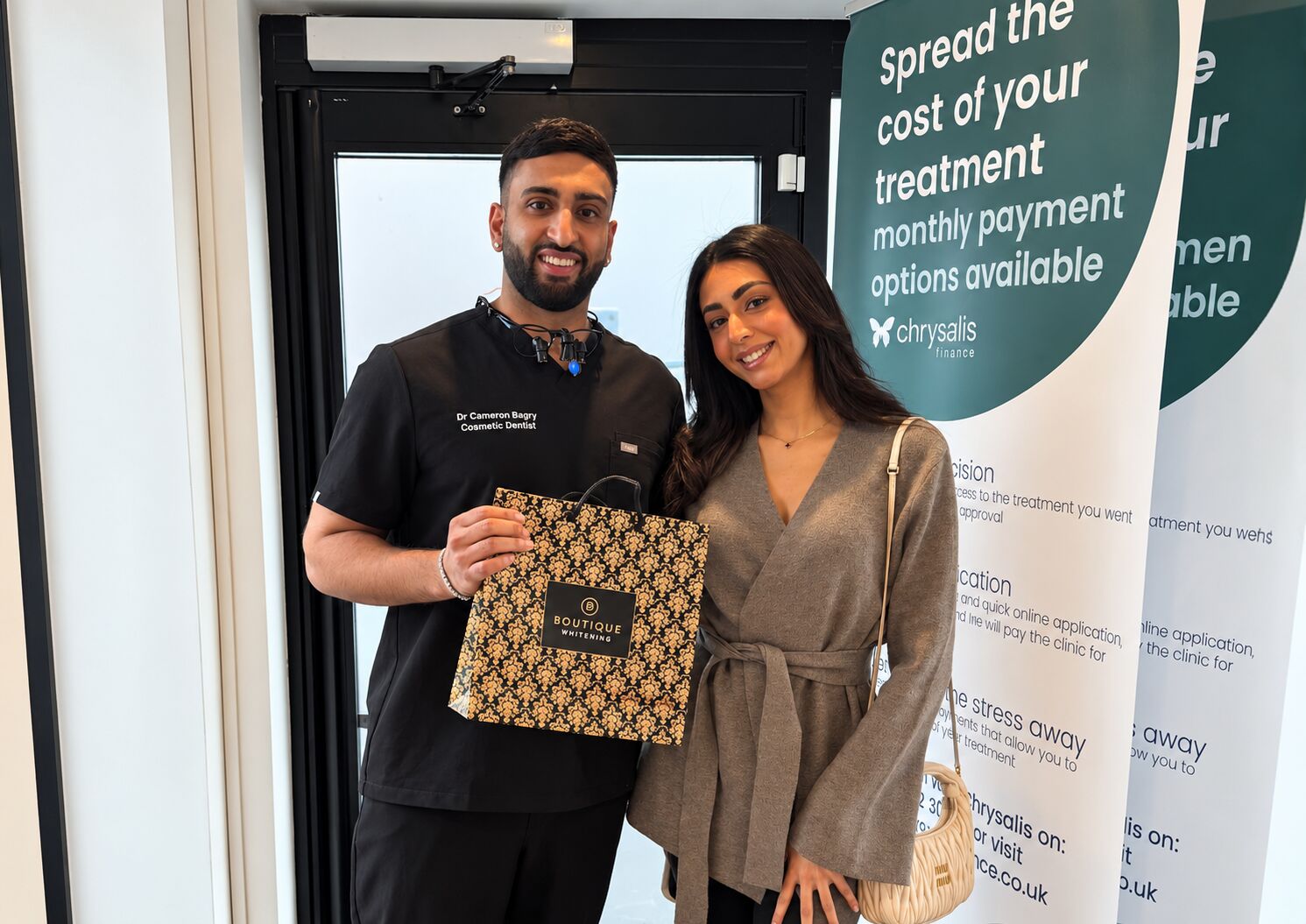
Meet your cosmetic dentist, Dr Cameron Bagry
Cameron is a cosmetic and restorative dentist in Telford. He holds a postgraduate diploma in cosmetic and restorative dentistry and a diploma in minimally invasive dentistry, and Totally Composite, one of the UK’s most respected bonding courses, asked him to be a clinical tutor teaching the technique to other dentists.
He plans every case himself, and seven of the nurses at his own practice have chosen to be treated by him, which is the review he is proudest of. He will also tell you when a smaller plan, or no treatment at all, is the better answer.
The questions patients actually ask
If your question isn’t here, call us and speak to treatment coordinator Ellie or fill in our contact form to send a question.
Often, yes. Internal whitening lightens the tooth from the inside and leaves the front surface untouched, which means keeping your own tooth rather than reducing it for a crown or a veneer. Whether it is suitable depends on the root treatment underneath and the condition of the tooth, and that comes from the assessment.
No. Resin infiltration works by drawing resin into the enamel rather than removing any of it, and it normally does not need an injection either. It is one of the least invasive treatments in cosmetic dentistry.
Usually not, though early decay can look similar, which is one reason it is worth having them looked at. Most white spots are demineralisation left over from braces, fluorosis, or developmental marks that formed while the tooth did.
It can make them look more obvious for a while, because the spots lighten faster than the tooth around them. That usually settles as the rest of the tooth catches up, and treating the spots afterwards is the normal order. It is temporary and it is expected.
White spot treatment is usually one. Internal whitening normally takes a few short visits, because the material is placed, sealed in and reviewed until the shade matches.
It can, over a long period, and it can usually be topped up if it does. Cameron will tell you what to expect for your particular tooth rather than giving you a blanket answer.
Start with a conversation, not a drill
Leave your number and treatment coordinator Ellie rings you back. Between you, you work out what you actually need, and nothing is booked until you want it to be.